
What Is ADOC? Alabama Department of Corrections
ADOC is the Alabama Department of Corrections, the statewide prison agency for sentenced Alabama prisoners. County jails are operated locally, usually by sheriffs, and handle recent arrests, pretrial detention, local sentences, municipal arrestees routed to the county, and short-term holds. ADOC custody begins after a person is sentenced to the state prison system or otherwise placed under ADOC custody or jurisdiction.
The ADOC homepage confirms the agency branding and statewide corrections navigation.
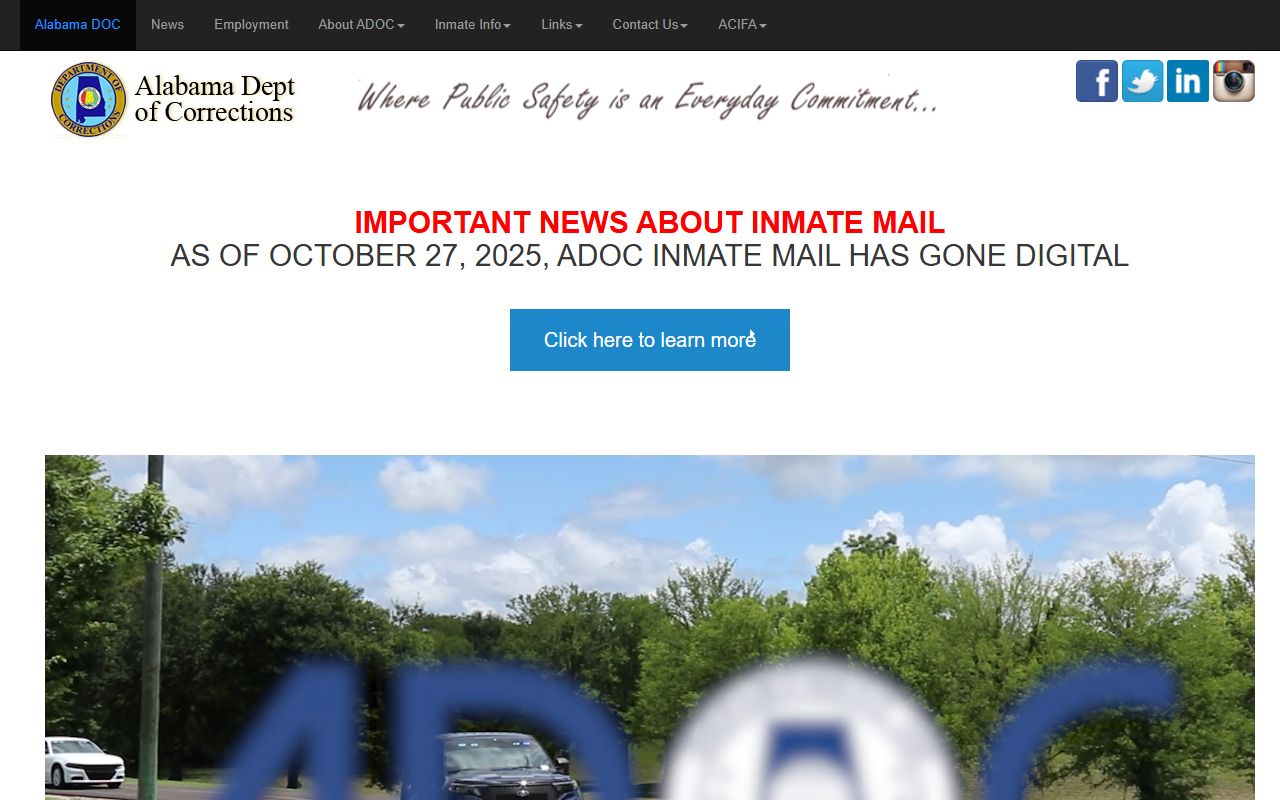
That agency-wide source anchors the ADOC inmate population page to the Alabama state prison system, not a local jail.
ADOC describes itself as Alabama's largest law-enforcement agency, with 28 facilities and nearly 2,000 officers. Its correctional-facilities page organizes the system into Central Office, 14 major correctional facilities, 12 community-based facilities or community work centers, and Alabama Therapeutic Education Facility as a private or contracted facility.
The ADOC Inmate Population
The April 2026 ADOC Monthly Statistical Report is the dated population snapshot used here because it was the latest monthly report listed in the research. At month end, ADOC reported a total jurisdictional population of 28,568, a custody population of 21,729, and an in-house population of 21,169. The live ADOC inmate-search page showed a separate lookup total of 27,736 when inspected, but that live figure is not the same dated trend source and excludes Youthful Offender Act records.
ADOC's statistical reports index is the source path for the monthly population reports.
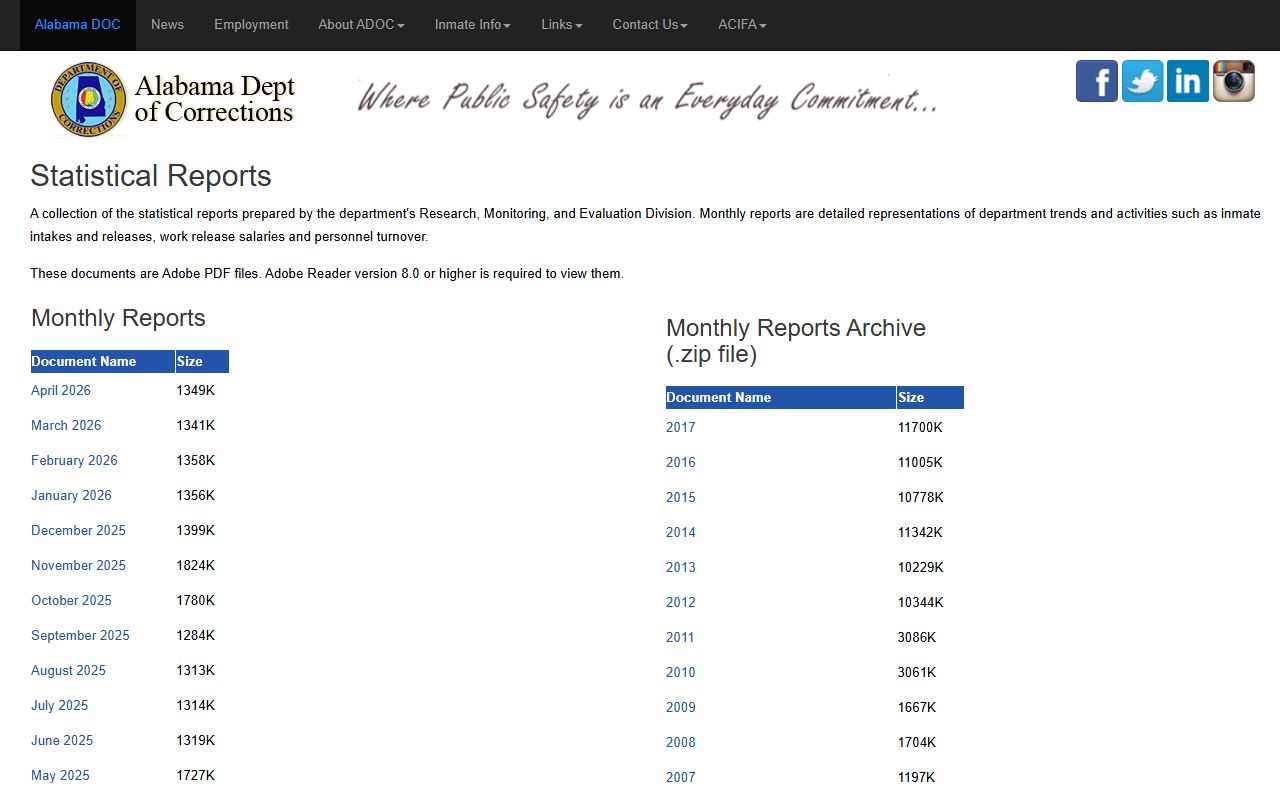
Using a dated monthly report keeps the ADOC inmate population figures separate from live locator totals.
| Measure | Figure | Source / Date |
|---|---|---|
| ADOC jurisdictional population | 28,568 | ADOC April 2026 Monthly Statistical Report |
| ADOC custody population | 21,729 | ADOC April 2026 Monthly Statistical Report |
| ADOC in-house population | 21,169 | ADOC April 2026 Monthly Statistical Report |
| Major correctional facilities | 14 | ADOC correctional-facilities page |
| Community-based facilities / work centers | 12 | ADOC correctional-facilities page |
How to Search the ADOC Inmate Locator
The official ADOC inmate locator is doc.alabama.gov/inmatesearch.aspx. ADOC says the database contains only currently incarcerated inmates, does not provide historical data online, and does not include inmates sentenced under the Youthful Offender Act. Use this locator for the ADOC inmate population after a person has been sentenced or transferred to state prison custody.
The official ADOC inmate search page shows the AIS, first-name, and last-name fields used for current state-prison lookup.
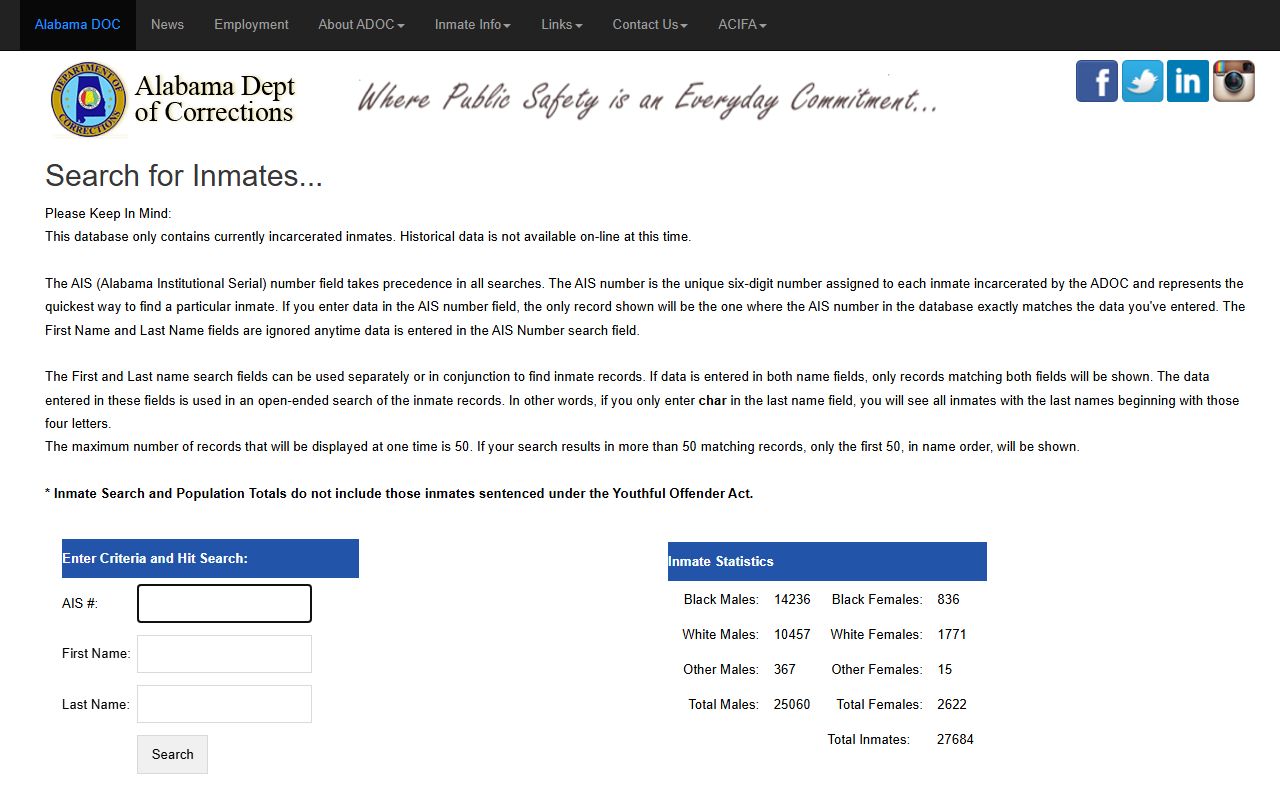
Those fields explain why AIS is the most precise search route when the number is known.
- Open the official ADOC inmate search.
- Use the AIS number when available; ADOC says the Alabama Institutional Serial number is the unique six-digit number assigned to each ADOC inmate.
- If AIS is unknown, search by last name first, then add first name if the result list is too broad.
- Use partial name beginnings or spelling variations if the person does not appear.
- If the person was just arrested or recently sentenced, check the county jail roster and court record because transfer and data entry can lag.
ADOC states that an AIS search takes precedence over name fields. If an AIS number is entered, the database returns only an exact AIS match and ignores the first-name and last-name boxes. Name searches can be open-ended, but displayed results are capped at 50 records at one time.
What an ADOC Inmate Record Shows
ADOC definitions explain the fields used in state-prison records. These fields do not replace court orders or Parole Board decisions, but they help read a current ADOC inmate locator result.
The ADOC definitions page explains custody levels, suffixes, jail credit, minimum release date, and parole-related fields.
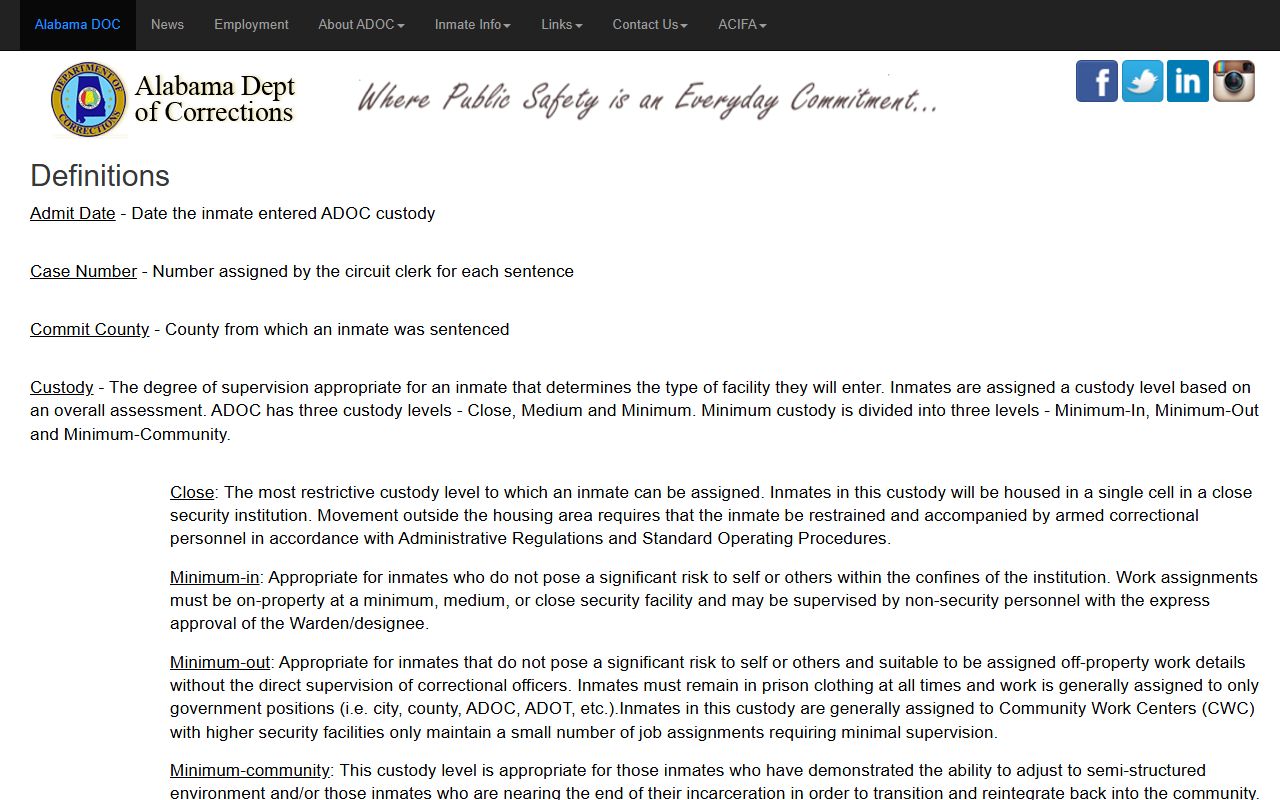
Those definitions are useful when a locator result includes state-prison terms that do not appear on county rosters.
| Field | What It Shows |
|---|---|
| AIS Number | The Alabama Institutional Serial number assigned to an ADOC inmate. |
| Admit Date | The date ADOC records the person as admitted to the state system. |
| Commit County | The county tied to the sentence or case commitment. |
| Custody | The supervision level, including Close, Medium, or Minimum categories. |
| Jail Credit | Time spent in county jail before sentencing, prepared by the circuit clerk of the sentencing county. |
| Minimum Release Date | The earliest scheduled release to probation or end of sentence, subject to change for lost good time or sentence changes. |
| Parole Consideration Date | The tentative Parole Board consideration date, when applicable. |
ADOC Prisons and Facilities
ADOC major institutions listed in the research include Bibb, Bullock, William E. Donaldson, Easterling, Elmore, G. K. Fountain, Hamilton, William C. Holman, Kilby, Limestone, St. Clair, Staton, Julia Tutwiler, and Ventress. Community-based facilities and community work centers include Alex City, Birmingham, Camden, Childersburg, Elba, Frank Lee, Hamilton, Loxley, Mobile, Montgomery, North Alabama, and Red Eagle. Alabama Therapeutic Education Facility is listed as the private or contracted facility row.
The ADOC correctional facilities page lists the statewide facility categories used for prisons and community work centers.
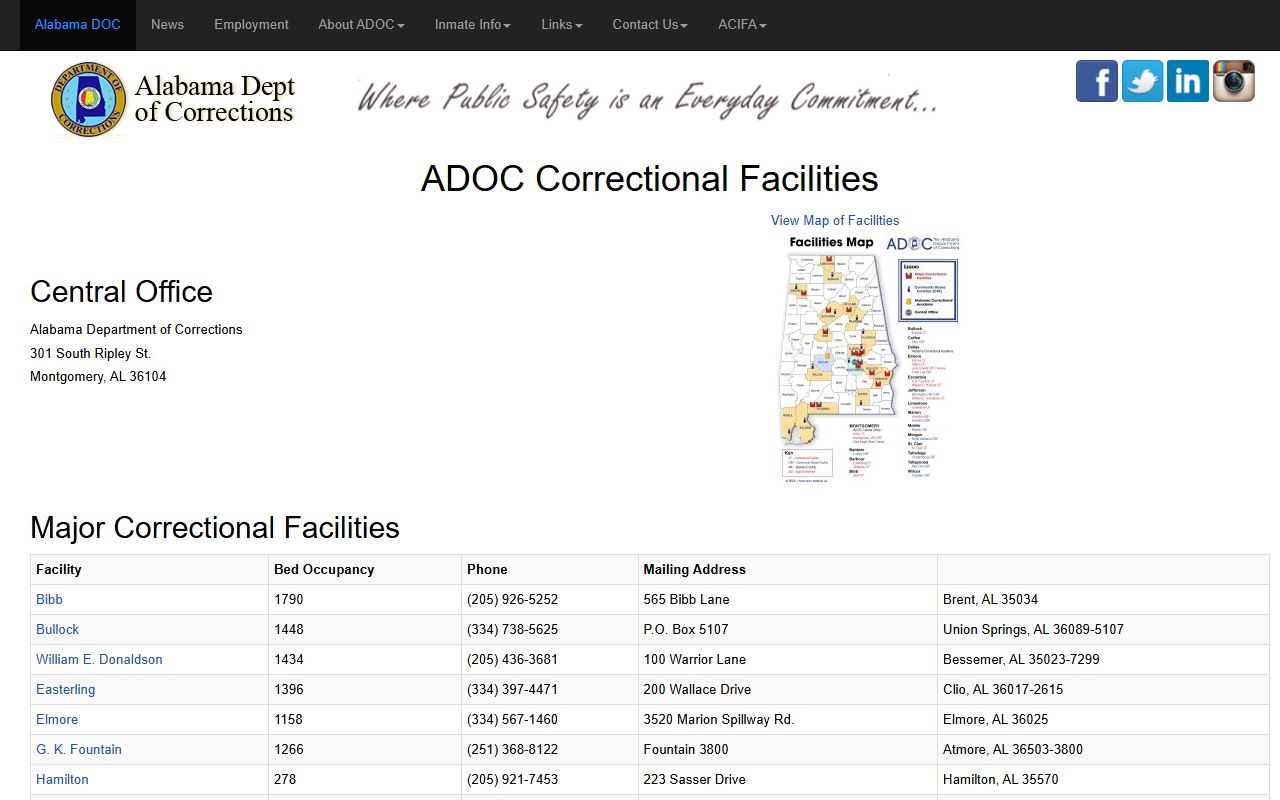
That list supports the statewide ADOC facility discussion and the broader facility directory.
ADOC custody levels are not one uniform security type. Its definitions page lists Close, Medium, and Minimum custody, with Minimum subdivided into Minimum-In, Minimum-Out, and Minimum-Community. Close is the most restrictive. Medium allows institutional treatment, work assignments, and other activities within an institution. Minimum-Community applies to people who have shown the ability to adjust to a semi-structured setting or are nearing release and may work in the community under supervision.
ADOC Inmate Population Trends
The April-to-April trend in the ADOC inmate population is upward over the four-year span captured in the research. ADOC custody population rose from 20,421 in April 2022 to 21,729 in April 2026. ADOC in-house population rose from 19,839 to 21,169 over the same April-to-April period, while jurisdictional population rose from 25,694 to 28,568.
| Monthly Report | Jurisdictional | Custody | In-House |
|---|---|---|---|
| April 2022 | 25,694 | 20,421 | 19,839 |
| April 2023 | 26,487 | 20,792 | 20,154 |
| April 2024 | 27,473 | 21,045 | 20,445 |
| April 2025 | 27,926 | 21,506 | 20,925 |
| April 2026 | 28,568 | 21,729 | 21,169 |
Sentencing, Parole, and Release in ADOC Custody
Sentencing starts in court. The Alabama Sentencing Commission maintains statewide sentencing standards, manuals, worksheets, and sentence-length tables. Its statute page identifies voluntary sentencing standards and intermediate punishments including split sentences, probation, and community punishment or corrections options. ADOC administers custody after the court commits a person to the state prison system.
Alabama good time is Correctional Incentive Time. ADOC definitions include good time received and good time revoked, and the minimum release date can change if disciplinary action removes good time or if the circuit clerk sends new cases or sentence changes. Executive Order 725, issued in January 2023, addressed uniform minimum standards for loss of good time and related accountability procedures.
Parole is handled by the Alabama Bureau of Pardons and Paroles, not by county jails and not directly by the ADOC web locator. ABPP says parole consideration eligibility is calculated under Ala. Code Section 15-22-28(e), with sentence, crime, jail credit, good-time eligibility, time served, and court orders affecting the calculation.
- Split sentence
- A court-ordered sentence that may include a period of confinement followed by suspended time and probation, subject to Alabama law and the sentencing order.
- Correctional Incentive Time
- Alabama's good-time system. It can reduce a sentence for eligible inmates, but it may be unavailable or revoked by discipline.
- Parole consideration date
- The tentative Board consideration point. It is not the same as a guaranteed release date.
ADOC vs. County Jail: Where to Look
The ADOC inmate population is sentenced state-prison custody and jurisdiction. Recent arrests, pretrial detainees, many municipal arrestees, and short local sentences usually appear on county jail rosters. A person can move from a county jail roster to ADOC after sentencing, and ADOC jurisdiction can still include people housed in county jails, community corrections, federal prison, another state facility, or a contract location.
| ADOC State Prison | County Jail | |
|---|---|---|
| Who is held | Sentenced state-prison inmates and ADOC jurisdictional cases | Recent arrests, pretrial custody, local sentences, and local holds |
| Run by | Alabama Department of Corrections | County sheriff or local jail authority |
| Where to look | ADOC inmate locator | County Directory |
ADOC Records Requests
ADOC Administrative Regulation 023, dated September 11, 2025, establishes ADOC public-records procedures. It says ADOC responds to properly submitted public-records requests and, after prepayment of applicable fees, provides ADOC public records to Alabama residents in accordance with applicable law. ADOC Form 023-A is required and includes a non-refundable $20 processing-fee instruction.
AR 023 lists submission methods: email to public.records@doc.alabama.gov, hand delivery to the Public Records Coordinator at ADOC's Legal Division at 301 South Ripley Street in Montgomery, U.S. mail to Post Office Box 301501, Montgomery, Alabama 36130-1501, or electronic submission on ADOC's public website. It says requests should not be submitted by telephone, fax, or unlisted methods.
| Request Route | Use It For | Research Note |
|---|---|---|
| ADOC online locator | Current ADOC inmate status | Current-only search using AIS, first name, or last name. |
| ADOC Form 023-A | Non-online ADOC public records | The form asks for requester details, Alabama residency, inmate identifiers, requested records, and proposed use. |
| Circuit clerk or Alacourt | Sentence, filed charges, jail credit, and case disposition | Jail credit and court orders come from the sentencing county court record. |
| County jail records | Recent arrests and local jail bookings | Do not send county jail roster requests to ADOC unless the record is an ADOC record. |
ADOC's statewide operating notices also affect families after a transfer. The homepage says inmate mail became digital on October 27, 2025, Access Secure Deposits is the exclusive ADOC deposit provider, and ICSolutions began providing ADOC inmate communication services on August 1, 2025. Those statewide notices apply to ADOC custody and should not be assumed for county jail mail, phone, or commissary systems.
ADOC Inmate Population FAQ
How big is the ADOC inmate population?
ADOC's April 2026 Monthly Statistical Report lists 28,568 people in ADOC jurisdiction, 21,729 in ADOC custody, and 21,169 in ADOC in-house population at month end.
How do I search the ADOC inmate locator?
Use the official ADOC inmate search by AIS number, first name, or last name. AIS is the most precise field and overrides name entries. The locator is current-only and excludes Youthful Offender Act records.
What is the difference between ADOC and a county jail?
ADOC is Alabama's state prison system for sentenced state-prison custody. County jails are local facilities for recent arrests, pretrial detention, short sentences, and local holds. Use the County Directory for jail rosters.